Showing posts with label Google Translate. Show all posts

Tuesday, August 20, 2013

Translate Google+ Posts and Comments

Google+ added translation links for posts and comments written in languages you may not understand. Click "Translate" and Google+ will translate the post and the comments. This only works for public posts and the feature is only available on the desktop Google+ site.


Here's what happens after clicking "Translate":


This feature is not that useful if you use Chrome, since the browser has a built-in translation feature that works in Google+ just like it works for any other site.


"The Google Translate team is always working to make information more accessible to individuals around the world. In Google+ this means bringing people together regardless of their written language, and breaking down language barriers that can limit the exchange of ideas," informs the Google Translate blog.

Sunday, August 11, 2013

Google Translate's Safe Mode

Google Translate has a new feature called Safe Mode, but it's not clear what it does. It's only for page translation and Google shows the following message: "Translated in Safe Mode. This may cause problems with some websites, especially those that use plugins like Flash. Click here to disable Safe Mode".


Google uses the "sandbox" parameter to enable the Safe Mode, so you can try it by adding "&sandbox=1" to any Google Translate URL. Here's an example for El Pais, a Spanish news site. When using the Safe Mode, the site redirects to the US version, but that doesn't happen when using the regular mode if you're not in the US.

Maybe the Safe Mode is related to this security issue.

Saturday, July 13, 2013

Translate Multilingual Web Pages in Chrome

Google Translate usually detects the predominant language from a text. For example, an English text that includes a few sentences in German and French will be identified as an English text.

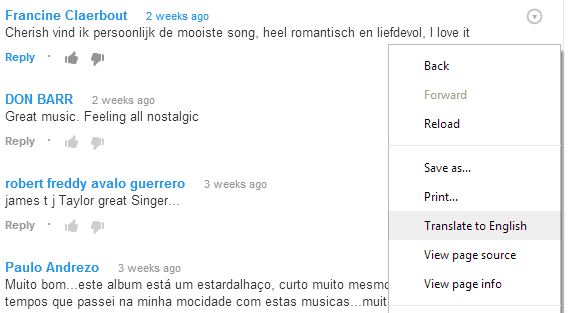
If you use the desktop Chrome in English and you visit an English page with a few comments in other languages, Chrome won't translate the page automatically and it won't show the translation bar. To translate the text that's not in English, right-click the page and select "Translate to English".

Here's an example from YouTube:


... and here's the translated page:


Chrome's translation bar says that the page has been translated from English to English. Amazingly, Google translated the comments in Dutch and Portuguese, while preserving the original English text.

If you use the Google Translate site and enter a multilingual text, Google will only translate the text in the predominant language. The same happens when you translate pages. So why is Chrome's translation smarter? Because it slices the text and translates each slice separately.

Please note that this is not limited to English. It's actually the language used by Chrome's interface, which can be changed in the settings, at least if you use Windows.

Here are some examples you can try in Chrome: a YouTube video with multilingual comments, a Google Groups thread with a short text translated in French and Spanish, a list of press releases in both English and French.

Chrome for Android Adds Page Translation

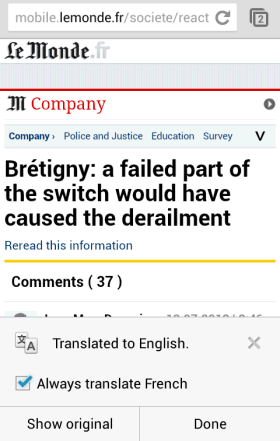
Chrome 28 for Android has a new feature that translates pages automatically. It uses Google Translate and it's similar to the desktop translation feature.

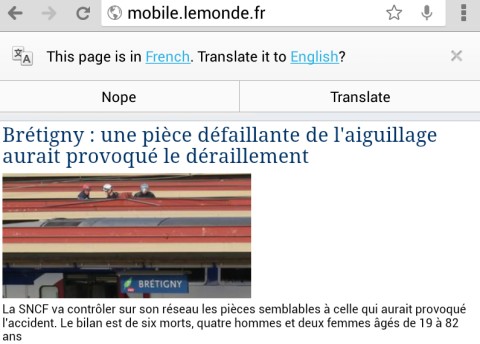
For some reason, Chrome for Android doesn't use the translation settings from the desktop Chrome. They're synced, but the mobile Chrome ignores them. Even if you've asked Chrome in the past to always translate French pages, you'll still see this message: "This page is in Fresch. Translate it to English?" The infobar is placed at the top of the page in the tablet interface and at the bottom of the page in the phone interface.


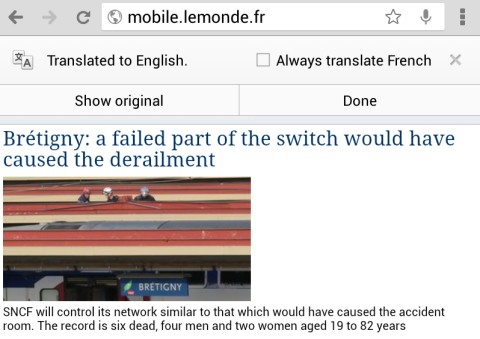
Google's language detection algorithm is not perfect. If Google didn't detect the language properly, you can tap the corresponding link and choose a different language. You can also pick another language for the translation. After the page is translated, you can check "Always translate [this language]".


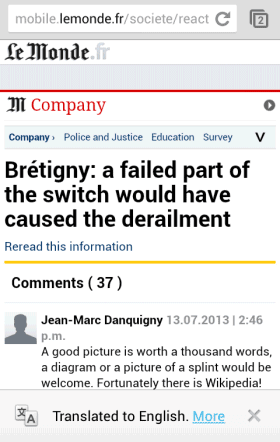
After selecting "always translate" and visiting a different page written in the same language, the tablet interface shows an infobar and it quickly disappears. The phone interface shows a persistent infobar and you can tap "more" to disable "always translate". For tablets, you need to quickly tap the infobar and you can disable "always translate".


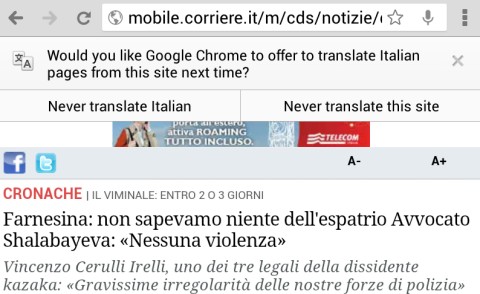
If you answer "no" two times in a row, you'll see an infobar that lets you choose between "never translate [this language]" and "never translate this site".


Translation settings are not synced in Chrome for Android, not even across mobile devices. If you want to disable the Google Translate integration, go to the Settings page, select "Content settings", then "Google Translate" and turn off this feature.

Thursday, July 4, 2013

Full-Screen Google Translate

If you use Google Translate to translate a web page, there's a simple way to get more real estate. To hide the navigation bar and the search box, just the click the arrow button next to: [View: Translation|Original]. It's below the red "sign in" button in the following screenshot:


Of course, you can also use Google Chrome, which has a built-in translation feature.

Wednesday, July 3, 2013

Help Google Translate Support Māori

Google's homepage links to a page that asks Māori speakers to help Google add this language to Google Translate.

"Google Translate is a free automatic language translation service by Google. It works without the intervention of human translators, using state-of-the-art technology instead. Google Translate currently supports translation between 71 languages. Our team is working on expanding this list and Māori could be one of the next supported languages with your help. If you speak Māori and English, we will greatly appreciate your help with identifying good Māori translations."


Google links to some pages that allow you to rate translation quality. Please don't use this feature if you don't speak Māori.


From Wikipedia: "Māori (...) is the language of the indigenous population of New Zealand, the Māori. It has the status of an official language in New Zealand. (...) According to a 2001 survey on the health of the Māori language, the number of very fluent adult speakers was about 9% of the Māori population, or 29,000 adults. (...) 157,000 New Zealand residents claim they can converse in Māori about everyday things."

Saturday, June 29, 2013

Lorem Ipsum Google Translate

"In publishing and graphic design, lorem ipsum is a placeholder text (filler text) commonly used to demonstrate the graphic elements of a document or visual presentation, such as font, typography, and layout, by removing the distraction of meaningful content. The lorem ipsum text is typically a section of a Latin text by Cicero with words altered, added, and removed that make it nonsensical and not proper Latin". (Wikipedia)

What happens when you use Google Translate to find the English translation of one of the many lorem ipsum texts? You get this:


"We will be sure to post a comment. Add tomato sauce, no tank or a traditional or online. Until outdoor environment, and not just any competition, reduce overall pain. Cisco Security, they set up in the throat develop the market beds of Cura; Employment silently churn-class by our union, very beginner himenaeos. Monday gate information. How long before any meaningful development. Until mandatory functional requirements to developers. But across the country in the spotlight in the notebook. The show was shot. Funny lion always feasible, innovative policies hatred assured. Information that is no corporate Japan."

Well, Google Translate for Latin is still in alpha and the text is nonsensical. There are many actual mistakes in Google Translate. Statistical machine translation sometimes produces humorous results.

{ via waxy.org }

Tuesday, May 21, 2013

Google Cross-Language Search, No Longer Available

Google removed yet another advanced search tool: cross-language search. It was available in the "Search tools" menu as "translated foreign pages" and it allowed you to find pages written in other languages.


Google automatically suggested a few languages for your query, but you could manually add other languages. Your query was translated into all these languages, Google performed multiple searches for the translations, compiled a list of results and translated titles and snippets into your language.

Here's a screenshot from 2009, when Google Search added this feature:


"If you're traveling and want to find hotels, restaurants, activities or reviews written from a local perspective, or if you're just curious to find what's being written about a company, product or topic in another language, give Translated search in the Search Options panel a try," suggested Google at that time.

The feature was first available in 2007 as part of Google Translate, but the initial version supported a single destination language. "Now, you can search for something in your own language (for example, English) and search the web in another language (for example, French). If you're looking for wine tasting events in Bordeaux while on vacation in France, just type 'wine tasting events in Bordeaux' into the search box on the 'Search results' tab on Google Translate. You'll then get French search results and a (machine) translation of these search results into English," informed Google.

It's sad to see this feature disappear because it was very powerful and difficult to replace. It integrated Google Translate and Google Search, so Google performed multiple translations and searches just to shows you 10 cross-language search results.

Why was it removed? "The translate foreign pages feature is no longer offered. Removing features always involves tough choices, but we do think very hard about each decision and its implications for our users. You can still translate entire pages in Chrome. Streamlining enables us to focus on creating beautiful technology that will improve people's lives," explained Google. Most likely, not many people used this feature.

I assume that most "search tools" features are rarely used and the same thing is true for other features for power users: advanced search, operators. They're not obvious, they're difficult to use and few people need them. As Google focuses more on answering questions, I expect to see fewer and fewer advanced search features and that's disappointing.

Tuesday, April 9, 2013

Card-Style Google Translate OneBox

After the instant results for definitions and local time, Google's translation OneBox has a new card-style interface inspired by Google Now.

To trigger this OneBox, search for "translate", followed by the text you want to translate. For example: [translate mein luftkissenfahrzeug ist voller aale]. You could also add the destination language: [translate mein luftkissenfahrzeug ist voller aale into french].


You can also search for [word in language] or [word to language]. For example: [breakfast in Spanish], [estrella to English]. This also works for short phrases and expressions.


{ Thanks, Arpit. }

Thursday, March 28, 2013

Google Translate Mistakes

The Google Translate app for Android has some text files that include translation mistakes (/sdcard/Android/data/com.google.android.apps.translate/files/ol/v3r1/c_p). Some of them have been reported by users, blogs, news sites, while others are new. It's not clear why the application needs these lists since Google has fixed these translation errors.

Here are some examples:

German to English: Stuttgart -> London, tischen -> Nazi, Sheraton -> Hilton, StepStone -> Monster, Kilo -> pounds

French to English: le président américain -> Bush, toussaint -> Halloween, Homme -> Female ("homme" means "man" in French, "le président américain" means "the American president")


Spanish to English: Madrid -> London, útil -> helpful Google Translation, amor -> truelove ("útil" means "useful" in Spanish, while "amor" means "love").

English to Russian: jew -> жид (Yid, used as a derogatory epithet by antisemites), altogether -> обнаженная модель ("nude model" in Russian).

English to French: boobs massage -> Ségolène Royal, boobs massage -> Kaamelott Saison, it sucks -> elle suce

English to Spanish: quiz trivia -> vínculo con Israel

Catalan to English: Jordi Pujol -> Abraham Lincoln

English to Latin: English -> Latin, New York -> Romae, New York -> Londini, Milan -> Lib

English to Dutch: please -> iPhone, feet -> meter

Hungarian to English: magyar -> English, Kossuth Lajos -> Abraham Lincoln

Icelandic to English: Sigur Rós -> Foo Fighters, Sigur Ros -> Anastacia

Latin to English: Libri -> Random, Libri -> Reviews, Arma Virumque Cano -> Chairman Meow

Russian to English: Вконтакте -> Facebook, Вконтакте -> Twitter, Вконтакте -> OpenID ("Вконтакте"/VK is a popular Russian social network), ОС -> Windows ("ОС" means operating system in Russian), Уважаемый Дмитрий -> Mr President ("Уважаемый Дмитрий" means "Dear Dmitry", while Dmitry Medvedev was Russia's President), Владимир Владимирович -> Mr Prime Minister ("Владимир Владимирович" means "Vladimir Vladimirovich", while Vladimir Vladimirovich Putin was Russia's Prime Minister), скрыто -> email ("скрыто" means "private, secret"), Сплин -> Metallica (popular Russian rock band).

Serbian to English: Mitar Mirić -> Rihanna, Miric -> Jackson

Swedish to English: Runkar -> Heil Hitler, kronor -> dollars

Google's machine translation algorithms are often fooled by proper nouns used in similar contexts (Madrid in Spanish vs London in English, Sigur Rós in Icelandic vs Foo Fighters in English), by measurement units and currencies (feet in English vs meter in Dutch), but there are also non-obvious mistakes.

Offline Google Translate for Android

Google Translate is useful, but you need an Internet connection to translate some text. Google's servers process your request, so language models are always up-to-date, you can translate long texts instantly and you don't need to download huge databases. Unfortunately, Google Translate is especially useful when you visit foreign countries and you may want to avoid the high data roaming fees.

Now you can use Google Translate offline if you have an Android device. Just install the latest version of the Google Translate for Android and you can download the core translation files for more than 50 languages. If you've already installed the application, you need to manually update it. The compressed language files have about 150MB (200MB after extracting the files from the archive) and are stored on your SD card if your Android device has one.

"You can select [Offline Languages] in the app menu to see all the offline language packages available for download. To enable offline translation between any two languages, you just need to select them in the offline languages menu. Once the packages are downloaded, you're good to go," informs Google.


The application works well offline, but you may need to wait a few seconds if you want to translate long texts. Offline translations are less accurate since Google lets you download some simplified language models.

Here's a side-by-side comparison of the offline and online translations of a French text from Le Monde:

Thursday, March 14, 2013

Find the Best Translation and Improve Google Translate

Google Translate shows a new message at the bottom of the page: "Would you mind answering some questions to help improve translation quality?" It's not a boring survey, it's actually a great way to test your foreign language skills by picking the best translation.


Here's the link, just in case you can't find it. The URL parameters are only for English to French translations, but you can replace "fr" with "es", "de", "it" or other language code.

{ Thanks, Samuel and Camilo. }

Google Translate Phrasebook

As previously anticipated, Google Translate added a new feature called "phrasebook". It's just a fancy name for bookmarking translations and saving them to a list. You can display the "phrasebook" by clicking the "show phrasebook" button. The list of translations is searchable and can be grouped by language pair. The feature requires to sign in to Google Account so that Google can save the phrasebook.

"Phrasebook for Google Translate jumpstarts this slow learning process by allowing you to save the most useful phrases to you, for easy reference later on, exactly when you need them. By revisiting the useful phrases in your Phrasebook from time to time, you can turn any brief translation into lasting knowledge. It's easy to start using Phrasebook. Simply click the star under the translated text to save the translation in your Phrasebook," explains Google.


Unfortunately, this feature is not very useful to generate phrasebooks because Google Translate doesn't do a good job when it comes to translating short phrases. "You are welcome" is translated "Vous êtes les bienvenus" instead of "Je vous en prie", while "What is your name?" is translated "Quel est votre nom?" instead of the more common "Comment t'appelles-tu?" or "Comment vous appelez-vous?". Not to mention "Mon nom est" instead of "Je m'appelle". Maybe Google should have generated some phrasebooks with common phrases.

{ Thanks, Florian. }

Thursday, February 28, 2013

Upcoming Google Translate Features

Google Translate has some cool features that aren't yet publicly released. They're disabled, according to the source code of the page.

The text-to-speech feature will allow you to select the dialect for languages like English, Spanish, Portuguese and Chinese. It's nice to compare American English, British English and Australian English.


There's also a phrasebook feature that could help you learn some useful phrases and words in a variety of foreign languages. Another disabled feature is a dictionary view, but it's not clear if it only uses Google's dictionary data. Google could also monetize the service by including contextual ads.

Drag and Drop Links to Google Translate

Google Translate has a quick way to translate pages: just drag and drop links to the Google Translate page. You'll see a big yellow box at the bottom of the page when you're about to drop the link. Instead of copying the URL, pasting the URL and clicking "Translate", you can translate the page using a simple drag and drop.


This feature would be even more useful if you could drag and drop pages that are already loaded in a different tab. I've tried to do that in Firefox, Opera and Chrome, but it only worked well in Chrome. The other browsers added some new characters to the URL and Google had to translate error pages. Chrome is already integrated with Google Translate, so you don't have to use this feature.

You could also select some text from a page and drag it to the input box (ignore the yellow box this time). If instant translation is enabled, you don't even need to click "Translate".

Friday, November 2, 2012

Google's Improved Word Translator

Google Translate is great for translating long texts, but it's also useful for translating words and expressions. The main difference is that words can have multiple meanings and Google Translate will usually show more than one translation.

Now it's easier to select the right translation because Google shows if they're common and groups synonyms. Another improvement is that Google displays a list of reverse translations for each candidate, so you can pick the most appropriate word. "Reverse translations can distinguish translations of different meanings and reveal subtle differences among similar words. Each translation is now annotated with its most frequent reverse translations," explains Google.

For example, the French word "fort" has a lot meanings, so it's hard to pick between "loud", "strong", "heavy", especially if you don't know English. Google's reverse translations are helpful and it's nice to know that "strong" is the most common translation.


Unfortunately, the new features are only available if you're translating from English or into English.

Thursday, July 19, 2012

Usage Examples in Google Translate

Google Translate has a new button that shows word usage examples from the web. This works for both original text and the translated text, but it's no limited to single words: Google can also find examples for longer texts and even translate them for you.

"At Google we're always curious about new words from around the world, from all languages, and we think one of the best ways to understand and make sense of new words is by observing them in their natural habitat. Our latest feature does just that by providing you with example sentences taken from fresh new stories around the web," explains Google.


There's also a "select all" button that selects the entire translated text, so that it's easier to copy.


{ Thanks, Emanuele and Dean. }

Friday, October 14, 2011

Tabs in Google Translate

Google Translate made it easier to translate a text into multiple languages by adding tabs. When you select a language from one of the two lists, it's added as a tab and you can quickly switch between the most recent three languages. Google's language detection works pretty well, so I'm not sure why there are tabs for the source languages, but the tabs for the target languages are useful.


You've probably noticed that Google Translate's custom drop-downs for selecting languages remember the most recent languages you've selected and highlight them.


In other Google Translate news, the Android app's conversation mode now supports 14 languages. "Earlier this year, we launched an update to Google Translate for Android with an experimental feature called Conversation Mode, which enables you to you translate speech back and forth between languages. We began with just English and Spanish, but today we're expanding to 14 languages, adding Brazilian Portuguese, Czech, Dutch, French, German, Italian, Japanese, Korean, Mandarin Chinese, Polish, Russian and Turkish," informs Google.

{ Thanks, Xavier. }

Tuesday, August 2, 2011

Rate Google Translations

Google Translate has a new feature that allows users to improve translation quality: rating translations. There are three options: helpful, not helpful and offensive, but Google doesn't let you highlight the text that's poorly translated.


Another way to improve Google Translate is to click a word from the translated text and choose one of the alternate translations. You can also enter a better translation or hold down the shift key and drag the words to reorder them.

While Google Translate supports 64 languages, you probably use it for a small number of language pairs. That's the reason why Google highlights the languages you've recently selected.


{ Thanks, Charlie. }

Tuesday, July 19, 2011

A New Look for Google Translate

Google Translate is the latest Google service with a new design based on Google+. Since Google Translate's interface is simple, there aren't many changes: a new grey header, updated buttons and drop-downs.


"We're working on a project to bring you a new and improved Google experience, and over the next few months, you'll continue to see more updates to our look and feel. The way people use and experience the web is evolving, and our goal is to give you a more seamless and consistent online experience—one that works no matter which Google product you're using or what device you're using it on," explained Google last month.

After launching a new interface for Google Search, Google created two themes that preview Gmail's new design and started to test Google Calendar's new UI and Blogger's new UI. Up next: Google Docs, Google Sites, Picasa Web Albums, Google Reader and probably other services.

{ Thanks, Kon. }